July 23, 2026
What Is a Zoho TRD? A Complete Guide for Zoho Partners
TRD Meaning in a Zoho Context
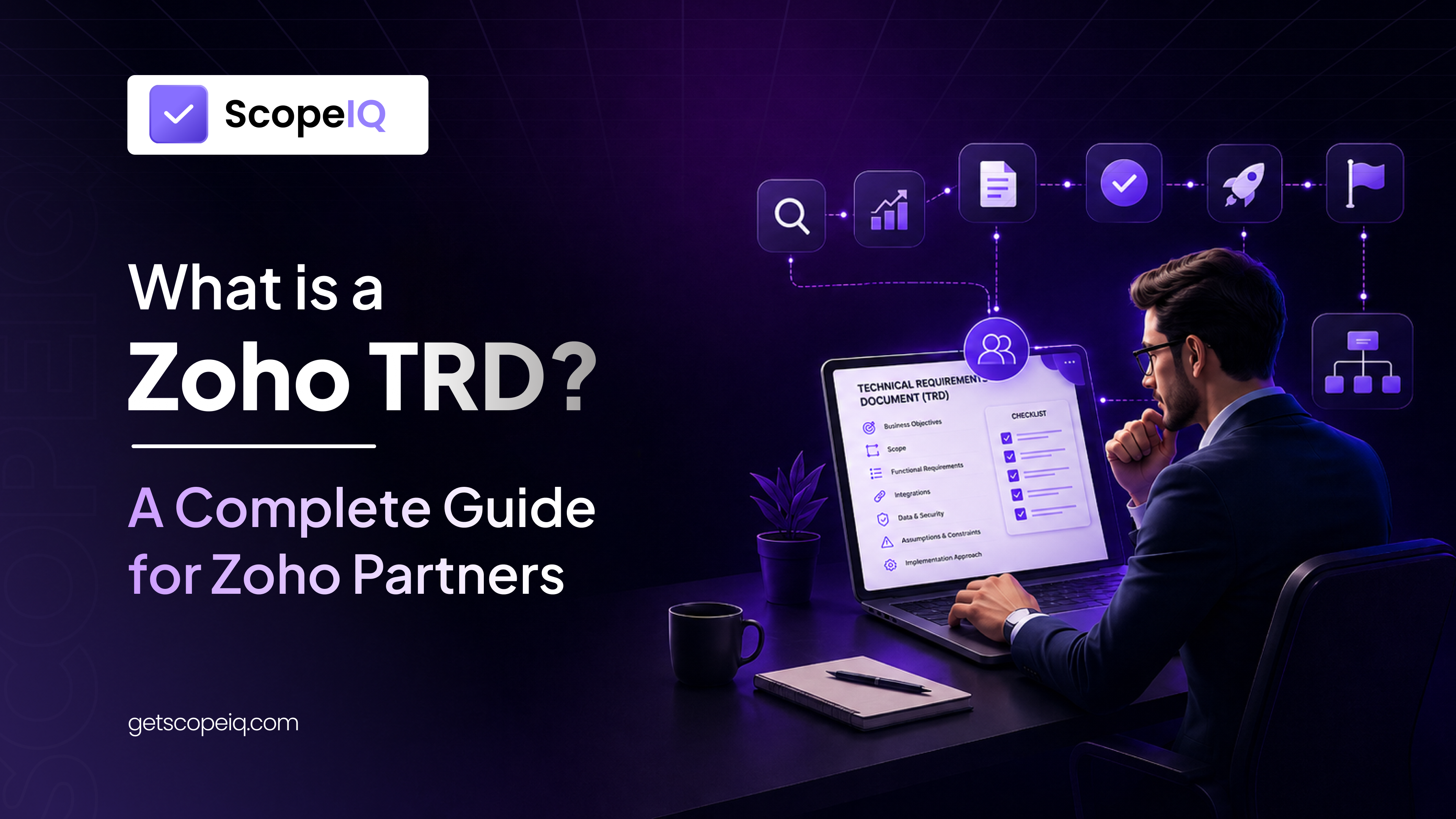
Zoho partners write a TRD before any implementation that involves custom modules, workflows, or integrations. TRD stands for Technical Requirements Document. It spells out how a system will actually be built: which modules get customized, which automations run, which integrations connect, and how data moves between them. It's written for the people doing the build, not for the client explaining what they want.
Related reading: Zoho FRD template · How to scope a Zoho project
Where the TRD Fits in the Implementation Process
A Zoho project usually moves through four stages before a single module gets configured: the client brief, the overview (with a first-pass pricing estimate), the FRD, and the TRD. The TRD sits after the FRD and before build starts. It takes the "what" from the FRD and turns it into a technical plan the implementation team can follow without guessing.
Zoho TRD vs FRD vs BRD
BRD — The Business Case
The BRD covers why the project exists. Business goals, current pain points, expected outcomes. No technical detail.
FRD — The Functional Scope
The Zoho FRD defines what the system needs to do from the user's side. Which processes it supports, which fields and forms are needed, what a user sees and clicks.
TRD — The Technical Blueprint
The TRD defines how those functions get built inside Zoho. Data model, workflow logic, integration points, custom code.
| Document | Answers | Written For |
|---|---|---|
| BRD | Why are we doing this? | Stakeholders, decision makers |
| FRD | What should the system do? | Client and project team |
| TRD | How will it be built? | Technical/implementation team |
What Goes Inside a Zoho TRD
Data Model and Custom Modules
Which standard Zoho modules get extended, which custom modules get created, field types, and how records relate to each other.
Workflows, Automations, and Blueprints
Workflow rules, schedules, and Blueprints that enforce process steps. This section should state the trigger, the condition, and the resulting action for each one.
Third-Party Integrations and APIs
Every external system the Zoho instance needs to talk to: payment gateways, accounting tools, marketing platforms. Includes authentication method and data direction (one-way or two-way sync).
Technology Stack and Deployment Model
Which Zoho apps and any supporting technology the build relies on, and how the rollout is structured, sandbox versus production, phased versus single deployment.
User Roles and Permission Architecture
Roles, profiles, and sharing rules. Who can see and edit what, and how that maps to the client's org structure.
Who Writes and Reviews a Zoho TRD
The Technical Architect's Role
The TRD is usually written by whoever is leading the technical build, not the account manager or the salesperson. It needs someone who understands both Zoho's technical limits and the specific client environment.
What Clients Actually Need to Understand
Most clients won't read the full TRD line by line, and they don't need to. What they need is confidence that someone mapped the technical side before billing started. A short summary section at the top of the TRD, written in plain language, usually covers this.
Why Zoho Partners Can't Skip the TRD
Common Failure Points Without One
Automations built without documentation that nobody can explain six months later. Integrations that get built to a different spec than what the client actually expected. Custom functions with no record of what they were supposed to do.
Real Cost of Undocumented Builds
Rebuilds. Change orders. Clients who lose trust in the partner mid-project because something breaks and there's no record of why it was built that way. This is usually where underpriced, underscoped projects turn into projects that cost the partner money instead of making it.
Sample Zoho TRD Excerpt
Module: Custom Deal Approval
Trigger: Deal stage changes to "Pending Approval"
Condition: Deal Amount > $50,000
Action: Blueprint transition requires Sales Director approval before stage can advance to "Closed Won"
Integration: On approval, deal data pushes to Zoho Books via API to generate a draft invoice
Permissions: Only users with the "Sales Director" profile can approve or reject at this stage
The TRD as Part of the Zoho Partner Toolkit
Where It Sits Alongside the FRD and Pricing Proposal
A TRD on its own isn't enough to run a project. It works alongside the FRD, which defines scope, and the pricing proposal, which turns that scope into hours and cost. All three need to agree with each other, or the project starts on mismatched expectations.
Why Most Zoho Partner Tools Don't Cover This Stage
Most Zoho partner tools handle delivery: CRM configuration, project tracking, client communication. Very few handle the stage before any of that starts, when a partner is turning a client brief into scope, technical spec, and price. That gap is usually filled manually, in Word docs, on the partner's own time.
How ScopeIQ Generates a Zoho TRD
ScopeIQ takes a client brief and produces an initial overview with a localized pricing estimate, then a complete FRD, then a TRD once the FRD is ready, each step reviewed before moving to the next. It's built specifically around how Zoho projects get scoped, not as a generic document generator. Export as a branded PDF and walk into the proposal call with the technical plan already done.
FAQ
Is a TRD required for every Zoho project?
Not always to the same depth. A single-module CRM cleanup might need a page. A multi-app Zoho One rollout with integrations needs a full document. The size should scale with the project's technical complexity, not follow a fixed template regardless of scope.
How long should a Zoho TRD be?
Long enough to cover every custom module, workflow, and integration without leaving gaps for the build team to guess. For most mid-sized projects, that's a few pages, not a single sheet.
Can a TRD change after the project starts?
Yes, but changes should go through a formal update, not a quiet edit. If the client requests something outside the original TRD, that's a scope change and should be priced and documented as one.